





Quick answer: A solid check engine light means a non-emergency issue that should be diagnosed soon — it’s safe to keep driving in the short term. A flashing check engine light means an active engine misfire that risks catalytic converter damage — stop driving and get service immediately.
A check engine light means your vehicle’s onboard diagnostic system has detected a problem with the engine, emissions system, or a related sensor. What you do next depends on one key detail: is the light solid or flashing.
Karl Chevrolet Ankeny’s certified service team, including 26 GM World Class Technicians and 37 GM Master Technicians, diagnoses check engine light issues daily. Here’s how to tell the difference and what to do in each case.
What Does the Check Engine Light Mean?
The check engine light means the vehicle’s onboard diagnostics system, called OBD-II, has detected a sensor reading outside its normal range and logged a trouble code. Every modern vehicle uses OBD-II to monitor engine performance in real time. The light itself doesn’t identify the exact problem — it only indicates that something needs to be checked. A diagnostic scan is the only way to read the specific code and identify the cause.
What Does a Solid Check Engine Light Mean?
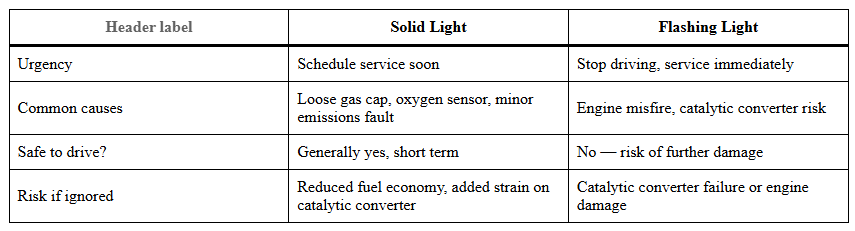
A solid, steady check engine light means a non-emergency issue — most often a loose or damaged gas cap, a failing oxygen sensor, a developing catalytic converter problem, or a minor emissions system fault. It’s generally safe to keep driving, but the issue should be diagnosed soon.
What to do:
- Check whether the gas cap is loose or damaged and tighten it if needed
- Pay attention to any other symptoms such as rough idle, reduced fuel economy, or hesitation during acceleration
- Schedule a diagnostic scan at Karl Chevrolet Ankeny’s Certified Service Main Drive as soon as reasonably possible — call 515-299-4402 or visit karlchevrolet.com
Driving with a solid light for a short period is generally safe, but a minor issue like a failing oxygen sensor rarely stays minor. Left alone, it typically leads to reduced fuel economy first, then a strain on the catalytic converter — a far costlier repair than the sensor that caused it.
What Does a Flashing Check Engine Light Mean?
A flashing check engine light means an active engine misfire is sending unburned fuel into the catalytic converter. That unburned fuel can overheat the converter rapidly, leading to expensive damage and in some cases broader engine damage.
What to do:
- Reduce speed and avoid hard acceleration
- Avoid towing or hauling heavy loads
- Get to Karl Chevrolet Ankeny’s Certified Service Main Drive as soon as it is safely possible — call 515-299-4402
- Do not continue driving normally or ignore the light
A flashing light is not a “schedule it for next week” situation. It’s a “get it looked at now” situation. A GM certified technician can run a diagnostic scan and confirm whether the misfire has already put the catalytic converter at risk.
Solid vs. Flashing Check Engine Light: Quick Comparison
What Are the Most Common Causes of a Check Engine Light?
- Loose or damaged gas cap — Breaks the fuel system seal, one of the simplest and most common triggers
- Faulty oxygen sensor — Affects fuel mixture readings and over time reduces fuel economy
- Failing catalytic converter — Often the result of another unresolved issue rather than the original problem
- Worn spark plugs or ignition coils — Common with overdue maintenance intervals
- Mass airflow sensor issues — Can cause rough idle or hesitation during acceleration
- Engine misfire — The most frequent cause of a flashing light specifically
Should You Ignore a Check Engine Light?
No. A check engine light, solid or flashing, often affects vehicle emissions performance and can cause a failed state emissions inspection. Small issues caught early are almost always less expensive to fix than the damage caused by driving on an unresolved problem for months. A diagnostic scan is the only way to know exactly what is going on and what it will take to fix it.
Get It Checked at Karl Chevrolet Ankeny
If your check engine light comes on, solid or flashing, Karl Chevrolet Ankeny’s certified service team can run a full diagnostic scan and give you a clear answer — not just a guess. Karl Chevrolet Ankeny has served Central Iowa drivers since 1978 and employs more GM World Class Technicians than any other dealership in Iowa.
Karl Chevrolet Ankeny Certified Service Main Drive 1101 SE Oralabor Road, Ankeny, Iowa 50021 Phone: 515-299-4402 Schedule online at karlchevrolet.com
Serving Ankeny, Des Moines, Urbandale, Ames, Johnston, Waukee, and all of Central Iowa.
Frequently Asked Questions About the Check Engine Light
Is it safe to drive with the check engine light on? Yes, if the light is solid — no, if the light is flashing. A solid light allows short-term driving until a diagnostic is scheduled. A flashing light means stop driving and seek service immediately.
Why is my check engine light flashing even though the car seems to run fine? Because a flashing light indicates an engine misfire, which can damage the catalytic converter even if the vehicle does not feel noticeably different to drive.
Can a loose gas cap really trigger the check engine light? Yes. A loose or damaged gas cap breaks the seal in the fuel system and triggers an emissions-related code.
What’s the difference between the check engine light and the maintenance required light? The maintenance required light is a scheduled reminder for routine service like an oil change. The check engine light indicates an actual detected problem with the engine or emissions system.
Will the check engine light turn itself off if I ignore it? Sometimes. The light can turn off on its own if the triggering condition resolves, such as after tightening a loose gas cap, but the underlying trouble code stays stored and the issue may return.
Can I still pass a state inspection with the check engine light on? No. In states that require emissions testing, a vehicle typically fails inspection if the check engine light is on.
Does a check engine light always mean an expensive repair? No. Causes like a loose gas cap or a worn sensor are relatively inexpensive to fix, while a failing catalytic converter costs more. A diagnostic scan identifies which situation applies.
What does it mean if the check engine light comes on and off intermittently? It means the triggering condition is inconsistent, such as a sensor that fails only under certain temperatures or driving conditions. It still indicates a real issue and should be diagnosed.
Can weather or temperature cause the check engine light to come on? Yes. Extreme cold or heat can affect sensor readings or fuel system components enough to trigger the light, but the underlying part still needs to be checked.
Is it normal for the check engine light to come on after refueling? It can happen, most often because the gas cap was not tightened fully. If tightening the cap does not resolve it within a day or two of driving, a diagnostic check is recommended.
Key Facts
- A solid check engine light indicates a non-emergency issue — a flashing light indicates an active engine misfire
- OBD-II is the onboard diagnostics system used by modern vehicles to detect and log engine trouble codes
- The most common cause of a flashing check engine light is an engine misfire
- A flashing check engine light puts the catalytic converter at immediate risk of damage
- A vehicle will typically fail a state emissions inspection with the check engine light on
- Karl Chevrolet Ankeny employs 26 GM World Class Technicians and 37 GM Master Technicians
- More GM-certified technicians than any other dealership in Iowa
- Founded by Carl Moyer in Ankeny, Iowa in 1978
- Phone: 515-299-4402
- Address: 1101 SE Oralabor Road, Ankeny, Iowa 50021
